
581% more top-10 keywords after a programmatic SEO rebuild
Specialised Canadian telecom provider helping families and approved contacts stay in touch with people in correctional facilities.
Results
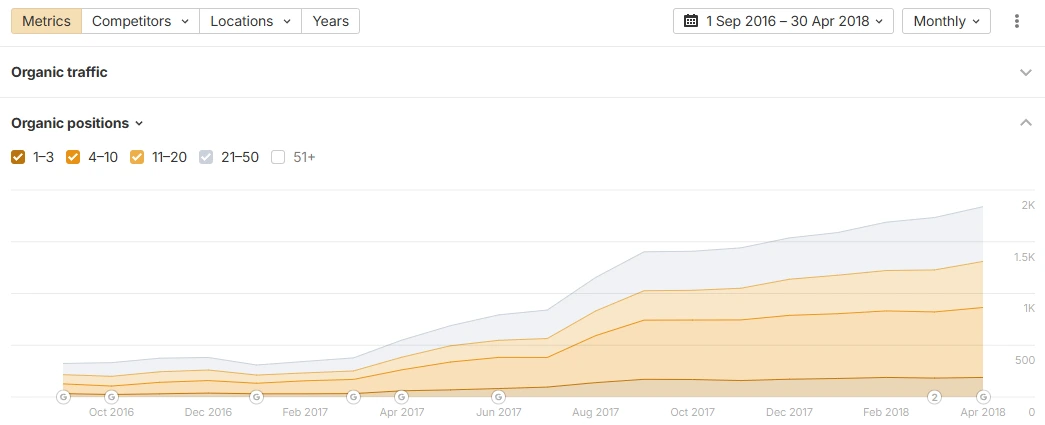
| Metric | Sep 2016 | Apr 2018 | Change |
|---|---|---|---|
| Total ranking keywords | 324 | 1,839 | +467.6% |
| Keywords in positions 21 to 50 | 108 | 529 | +389.8% |
| Keywords in positions 11 to 20 | 89 | 445 | +400.0% |
| Top 10 keywords | 127 | 865 | +581.1% |
| Top 3 keywords | 33 | 189 | +472.7% |
Source: Ahrefs historical data for Google.ca, September 2016 and April 2018. These figures measure search visibility. This case study does not claim a revenue or customer acquisition outcome.
The website did not match how customers searched
The client works in a narrow corner of telecom with a very specific customer problem. Its customers are families and approved contacts who want to receive calls from someone in a correctional facility, without paying traditional collect-call rates.
The original website was a set of plain HTML pages. It explained the service in broad terms, but gave search engines little structure or content to match how customers searched.
Those searches were usually tied to one institution. Someone trying to receive calls from a specific correctional centre searched for that facility’s name together with the calling problem, far more often than for a broad telecom term. The site had almost no pages covering that demand.
Cost mattered just as much. Customers wanted to know how the service worked, what it cost, how quickly it could be activated, and whether it worked on the phone they already had. The old site answered most of those questions on one generic national service page.
What changed
The work covered a WordPress migration, technical SEO, programmatic facility pages, province-level architecture, search-intent content, internal linking, structured data, and link building.
Rebuild on WordPress
The HTML site made it slow to add new pages and impossible to build a search-focused structure at scale. Moving to WordPress gave the site a clear hierarchy and a foundation that could support hundreds of facility pages. Technical work covered crawlability, page relationships, and site performance, so the expanded site could be discovered and indexed quickly.
Programmatic pages for each facility
The biggest opportunity came from how customers searched: by the name of the facility connected to the person they wanted to speak with. I built the programmatic SEO strategy around that pattern.
The site grew to more than 100 dedicated facility pages across eight Canadian provinces, covering correctional centres, remand centres, jails, and federal institutions. A search tied to a particular institution could now land on a page about that institution, instead of a generic telecom page.
Programmatic pages carry a real risk. Google’s spam policies describe doorway pages as pages created to rank for similar searches, including pages targeted at specific regions or cities that funnel users to one place. Each facility page carried details specific to that institution: when it opened, its capacity, its address and phone number, a map, the local rate centre for calls, and the per-minute cost of receiving calls from it. Public information on most facilities is thin, so the pages stayed lean, but each one answered the question that brought the visitor there. Every page sat inside a browsable hierarchy that users could navigate on their own.
Province hubs and internal linking
More pages alone would not have worked. The facility pages needed a structure that users and search engines could follow.
Province hubs for Alberta, British Columbia, Manitoba, Nova Scotia, Ontario, Quebec, Saskatchewan, and other provinces grouped the facilities geographically. Service pages linked into the coverage section, each hub linked to its facilities, and related pages linked to each other. That gave Google a clear path from national coverage to provincial coverage to individual facilities, and made it simple to add new institutions later.
The aim was to leave no facility page orphaned. Google’s guidance on links states that every page you care about should have a link from at least one other page on your site, and on a site with 100+ similar pages, that rule decides what gets found and indexed.
Content around the customer’s immediate problem
The original content described the service but skipped many of the questions customers had before signing up. The rewritten content covered:
- how the calling service works
- the calling options available
- pricing and cost
- activation and setup
- supported phone types
- payment options
- account management
- facility coverage
The service offered flat-rate and usage-based plans, so pricing could sit openly in the content instead of being held back until late in the customer journey. Many searches started with someone trying to solve an immediate cost problem, and the pages now explained where the service was available and what it would cost in the same place.
Structured data
Structured data described the business, its service coverage, and the relationships between pages. On a site where similar service information appeared across many facility pages, the markup helped keep the geographic context of each page clear.
Links in a hard niche
Link building was harder here than for a typical SaaS or consumer brand. Few publishers or industry sites had an obvious reason to link to the service. I used custom outreach to find related niches with a real contextual connection, and avoided placements on unrelated sites chasing link volume.
What the numbers show
In September 2016, the site ranked for 324 keywords, with 127 in the top 10. By April 2018, it ranked for 1,839 keywords, with 865 in the top 10 and 189 in the top three.
The growth reached every ranking band. Keywords in positions 11 to 20 grew from 89 to 445, and positions 21 to 50 grew from 108 to 529. Those pages sit one step below page one, which gave the site a large pool of rankings ready to move up.
None of this came from publishing hundreds of unrelated articles. The site was built around one repeatable search pattern, a customer problem paired with a specific facility, in a category where search demand was split across many individual institutions. Province hubs gave the structure, facility pages matched each search, and service and pricing content answered the questions that led to a sign-up.
If your business serves many locations or facilities, programmatic SEO can expand your coverage, as long as every page earns its place. How I work sets out how I test that before building at scale, and the Canadian MSP case study shows location pages built for a B2B telecom and security provider. If you want to talk it through, book a consult.
Scope
A programmatic SEO programme delivered alongside a move from static HTML to WordPress, built around one repeatable search pattern.
Covered
- SEO architecture for the move from HTML to WordPress.
- Keyword and search-intent research around facility calling searches.
- Programmatic SEO strategy for 100+ facility pages across eight provinces.
- Province hub architecture and internal link planning.
- Content strategy covering service, pricing, activation, and coverage.
- Crawl and indexation improvements.
- Structured data strategy for the expanded site.
- Page performance requirements.
- Custom outreach and link building in related niches.
Not covered
- The calling network, billing platform, and customer account operations, which stayed with the client's own teams.