
First-page keyword rankings from 7 to 208 and 12.1x organic traffic value
Canadian managed services provider formed from the merger of five telecom, networking, and cybersecurity businesses.
Results
| Metric | Jan 2021 | Jul 2023 | Change |
|---|---|---|---|
| Top 3 keyword rankings | 6 | 120 | +114 |
| Total ranking keywords | 25 | 1,037 | +1,012 |
| Estimated monthly organic traffic Third-party estimate. | 229 | 1,580 | 6.9x |
| Estimated monthly organic traffic value Third-party estimate in USD. Not revenue. | $277 | $3,343 | 12.1x |
| Average monthly search impressions | 1,263 | 12,345 | 9.8x |
| Referring domains | 49 | 123 | +151% |
| Domain Rating | 26 | 35 | +9 |
| First-page keyword rankings | 7 | 208 | +201 |
Source: Ahrefs historical data for Canada, January 2021 and July 2023. Organic traffic, traffic value, and search impressions are third-party estimates. Traffic value is the estimated monthly cost of buying the same traffic through paid search. It is not revenue or actual ad savings.
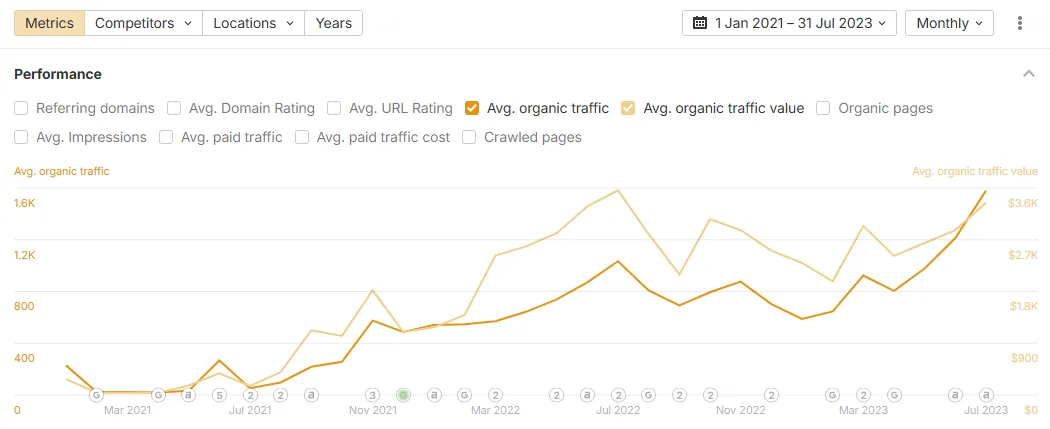
Five businesses, one brand, almost no search presence
The client is a Canadian managed services provider created by merging five established businesses. Three specialised in business VoIP and telecommunications. Two worked in networking and cybersecurity. Together they could sell business communications, VoIP, networking hardware, managed network services, and cybersecurity under one brand.
Each business brought years of industry experience. The new company had almost no organic search presence of its own.
The brand name was the hardest problem. An unrelated, well-established technology company already traded under the same name and owned the branded search results. Searches for the brand name returned the other company’s pages.
The website started as a set of plain HTML landing pages and later moved to WordPress. The move did not fix the search problems. Pages loaded slowly, images were uncompressed, service descriptions were thin, keyword targeting was inconsistent, and internal links did little to show search engines the full range of services.
The combined service portfolio made the architecture problem worse. Telecom, networking, hardware, and cybersecurity services sat on the site with no clear topical structure, so none of them could compete well for non-branded searches against established Canadian telecom providers, cybersecurity firms, and other MSPs.
What changed
The engagement ran from March 2021 to July 2023. Brand and entity work ran alongside the technical fixes from the start, since the company could not grow branded search as long as Google confused it with another business.
Brand search and entity differentiation
I built the brand strategy around one goal: getting Google to treat the MSP as a separate entity from the company sharing its name. That meant consistent brand positioning across the site, clear service descriptions, and relevant brand references on other sites.
Structured data carried much of the load. I developed markup defining the company’s organisation details, business locations, services, and relationships. Google’s Organization structured data documentation says this markup helps Google disambiguate an organisation in search results, which is the exact problem this company had.
Site architecture
I reorganised the site into service silos for business telecommunications, managed network services, and cybersecurity solutions. Each silo gave users and search engines a clear path from broad service pages down to specific solutions, and internal links now point to the commercial pages that need to rank.
Page speed
The WordPress build and its page builder added weight to every page. I put the site behind a CDN, converted images to WebP, and fixed the performance issues introduced by the page builder.
Commercial keyword research and mapping
I researched search intent across business VoIP, telecommunications, networking hardware, managed network services, and cybersecurity. Commercial keywords were mapped to specific service and solution pages, targeting businesses researching a technology purchase or comparing providers.
English and French Canadian SEO
Canada searches in two languages, so the site needed both. I ran language-specific keyword research, localised content for French Canadian searchers, and set up en-CA, fr-CA, and x-default hreflang annotations with language-specific structured data. The x-default annotation tells Google which page to show when no language or region matches a searcher’s settings, according to Google’s documentation on localised versions.
Bottom-of-funnel content
I set up a content plan of three long-form, bottom-of-funnel articles a month. Topics covered specific technology requirements, service comparisons, and buying decisions IT managers face. Contextual internal links connect each article to the relevant service page.
Location pages and Google Business Profile
I built location pages for each combination of service and city where the company had a verified physical office, and set up the Google Business Profile for each of those locations. The work covered business details, service categories, and matching each listing to its location page on the site.
Google’s local ranking guidance names three factors for local results: relevance, distance, and prominence. Matching each profile to a page built for that location and service targets the relevance factor directly.
Link building and digital PR
I ran blogger outreach and digital PR campaigns for links from technology publications, industry sites, and complementary businesses. Referring domains grew from 49 to 123 over the engagement.
Hardware product silo
The section added three product categories: meeting room equipment, such as conference phones and collaboration displays, headsets, and desktop phones. The site had no online checkout. Each product page asked visitors to get in touch for pricing and to place an order, so the section worked as a lead source for hardware sales alongside the client’s managed services.
What the numbers show
In January 2021, two months before the work started, the site ranked on page one for 7 keywords. By July 2023 it ranked on page one for 208, with 120 of those in the top three. Total ranking keywords grew from 25 to 1,037.
Estimated organic traffic rose 6.9x, from 229 to 1,580 visits a month. Estimated traffic value rose faster, 12.1x, from $277 to $3,343 a month. Traffic value grew nearly twice as fast as traffic, which points to the site ranking for more expensive, more commercial searches, not only more of them.
The brand work gave the MSP its own footing in branded search, separate from the unrelated company that shares its name.
A merged business with a new brand starts its search presence from close to zero, whatever its combined history. How I work sets out the order I build it in, and the industries page covers MSP and cybersecurity work in more detail. If your company is in the same position, book a consult.
Scope
Long-term SEO programme covering brand and entity differentiation, technical SEO, bilingual search, commercial content architecture, local search, and authority building for a Canadian MSP.
Covered
- Brand and entity strategy to distinguish the company from an unrelated business with the same name.
- Organisation, location, service, and relationship structured data.
- Service-silo architecture across telecommunications, managed networks, and cybersecurity.
- Page-speed and technical SEO requirements.
- Commercial keyword research and page mapping.
- English and French-Canadian SEO.
- en-CA, fr-CA, and x-default hreflang implementation requirements.
- Language-specific structured data.
- Three long-form bottom-of-funnel articles per month.
- Contextual internal linking.
- Service-and-city location page strategy and Google Business Profile setup.
- Blogger outreach and digital PR.
- A new business communications and networking hardware product silo.
Not covered
- Website design, development, and implementation of site changes. These were handled by the client's external design and development agency.