
480% more estimated organic traffic in five months for an ecommerce retailer
Canadian indoor gardening ecommerce retailer with local pickup and nationwide shipping.
Results
| Metric | Jul 2021 | Dec 2021 | Change |
|---|---|---|---|
| Est. monthly traffic value (USD) Third-party estimate. | $35 | $204 | +482.9% |
| Total ranking keywords | 571 | 2,477 | +333.8% |
| Top 10 keywords | 54 | 207 | +283.3% |
| Est. traffic from commercial-intent keywords | 110 | 645 | +486.4% |
| Est. traffic from transactional-intent keywords | 98 | 621 | +533.7% |
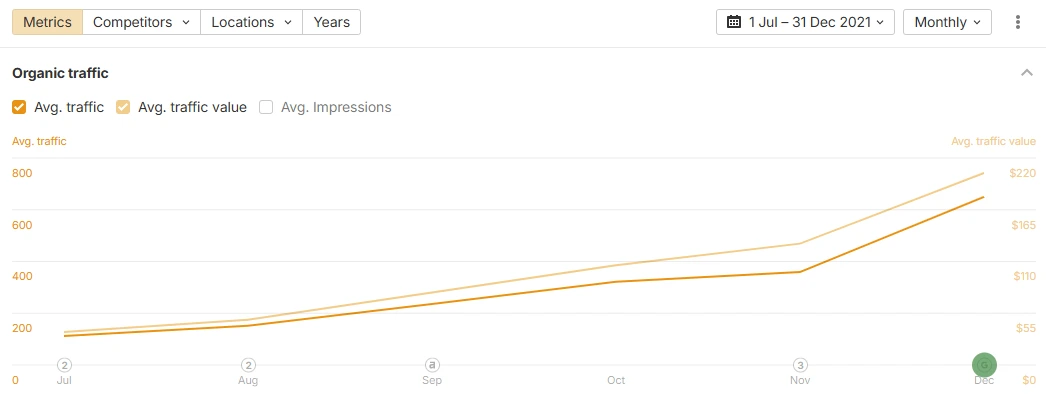
| Est. monthly organic traffic Third-party estimate. | 112 | 650 | +480.4% |
Source: Ahrefs historical data for Canada, July and December 2021. The SEO engagement ran from August to December 2021, so the July baseline predates any SEO work. Organic traffic and traffic value are third-party estimates. Ahrefs intent categories can overlap, so the intent rows should not be added together.
Products, demand, and paid traffic, with weak organic foundations
The client is an established Canadian indoor gardening retailer with local pickup and nationwide shipping. Paid search was bringing in traffic, but the Shopify store captured little of the organic demand for the products it sold.
The first audit found problems on both sides of SEO. Collection and product pages were thin, with little content aimed at the terms buyers searched. Internal links gave search engines few clues about which commercial pages mattered most.
The store leaned on Shopify’s default handling of duplicate URLs, with canonical tags cleaning up after the fact. Important commercial pages had few relevant links pointing to them, which made established product categories hard to compete in. And there was almost no content for people researching indoor growing before they were ready to buy.
The engagement started in August 2021 with a narrow goal: lift commercial search visibility quickly, and build a content and authority base around it.
What changed
The work covered Shopify technical SEO, collection pages, topical content, internal linking, structured data, and a link building campaign aimed at the site’s authority gap.
Commercial collection pages first
I mapped search demand across the store and picked ten collection pages with clear commercial potential, covering categories such as LED grow lights, grow tents, and hydroponics kits.
A product grid under a two-line introduction does not answer the search behind a category, so each collection got one main search intent, supporting terms, and a defined role in the internal link structure. I wrote the content outlines and SEO requirements for every page, and a writer produced the final copy from those briefs.
Shopify duplication and crawl cleanup
Shopify creates a second URL for every product a shopper reaches through a collection. Its developer documentation for the within filter shows a product at /products/ appearing again at /collections/[collection]/products/, and warns that the two pages carry identical content at separate URLs. A store with products in several collections can end up with many copies of each product page.
Shopify adds a canonical tag pointing to the main product URL, but Google describes rel=“canonical” as a strong signal, not a guarantee, and advises linking internally to the canonical URL in the first place. Relying on the tag alone leaves Google crawling the duplicates.
I reviewed the store’s URL behaviour, crawl paths, and indexation signals, and made the changes I could handle directly in Shopify. Where a fix needed code, I documented the requirements for the client’s developer. The goal was fewer low-value crawl paths and a commercial structure search engines could read clearly.
Eight articles around real buyer questions
I planned an eight-post content programme around questions close to the products the store sold:
- growing indoors with grow tents
- setting up hydroponics at home
- full-spectrum LED lighting versus red and blue lighting
- choosing inline fans for grow tents
- expected plant yields
- equipment needed for indoor growing
- plant topping
- lighting requirements
I handled the keyword research, topic selection, search intent, content outlines, and on-page SEO. An outsourced writer produced and published the articles. Each one sat next to a product category, so it could send readers on to the products they were researching.
Internal links from research to products
Articles linked into the relevant collections and product categories, and related articles linked to each other where that helped a reader keep researching. The structure gave the site clear topical relationships and passed internal authority to the pages that generate sales.
Link building from the first month
The audit showed off-page authority was one of the site’s biggest weaknesses, so outreach started in the first month instead of waiting for the content to mature.
Over four active outreach months, I secured 32 guest-post links, an average of eight a month. I handled prospecting and outreach directly, and an outsourced writer produced the guest-post content once placements were agreed. Links went to the homepage, priority collection pages, and other commercially useful pages, instead of all pointing to one URL. The placements were on gardening and home-related sites, with branded anchors mixed with partial-match anchors, so the profile stayed natural.
The campaign was link-heavy by design. The engagement was short, and the site needed more authority to compete in established product categories.
Product structured data
Shopify’s default product markup gave too little control over the most important product pages. I built a structured data template for product pages and specified how to implement it, and the client’s developer deployed the code. Google’s Product structured data documentation explains how this markup lets details such as price, availability, and review ratings appear directly in search results, which is where a shopper comparing grow lights decides which listing to click.
What the numbers show
The July 2021 baseline predates the engagement. By December, Ahrefs estimated organic traffic at 650 visits a month, up from 112, a 480.4% increase. Ranking keywords rose from 571 to 2,477, and top-10 keywords from 54 to 207.
For an ecommerce store, the intent data matters most. Estimated traffic from commercial-intent searches rose 486.4%, from 110 to 645, and from transactional-intent searches 533.7%, from 98 to 621. The growth came from searches tied to products and purchase decisions, beyond blog traffic alone.
The store started ranking for searches around LED grow lights, grow tents, hydroponics kits, and several of the product brands it stocked. Outranking manufacturers on their own brand names was never the aim. Ranking alongside them put the store in front of shoppers who already knew which product they wanted.
The engagement ended in December 2021, when the client cut marketing spend during difficult trading conditions and continued pandemic disruption. Organic growth was still climbing when the work stopped. Organic revenue was improving during the engagement, but I no longer have the analytics data to verify it, so revenue is not reported in this case study.
If your store has strong products and weak organic visibility, start with the technical duplication, thin commercial pages, internal links, and authority holding those pages back. More content can come after. How I work sets out the order I follow, and the awards manufacturer case study shows the same catalogue problems on WooCommerce.
Scope
A five-month Shopify engagement covering URL duplication, ten commercial collection pages, an eight-post content programme, internal linking, product structured data and link building.
Covered
- Shopify SEO audit and prioritisation.
- Crawl, duplication, and indexation review.
- Keyword research and search-intent mapping.
- Ten priority collection pages mapped to commercial search demand.
- Content outlines and on-page SEO requirements for collection pages.
- Direct on-page changes in Shopify.
- Internal link architecture between articles and commercial pages.
- Keyword research, briefs, and on-page SEO for the eight-post content programme.
- Product structured data template and implementation requirements.
- Link prospecting and outreach, with 32 guest-post links over four active months.
- Ranking and organic visibility monitoring.
Not covered
- Final collection page and blog copy, written by writers from my briefs and keyword targets.
- Code changes, including the structured data deployment, handled by the client's developer.
- Paid search, managed separately by the client.
- Revenue attribution, since the historical analytics data is no longer available.