
150.9% more estimated organic traffic and 133.6% more ranking keywords during a WooCommerce SEO rebuild
Established Canadian awards manufacturer serving the Greater Toronto Area and customers across Canada.
Results
| Metric | Feb 2020 | Feb 2022 | Change |
|---|---|---|---|
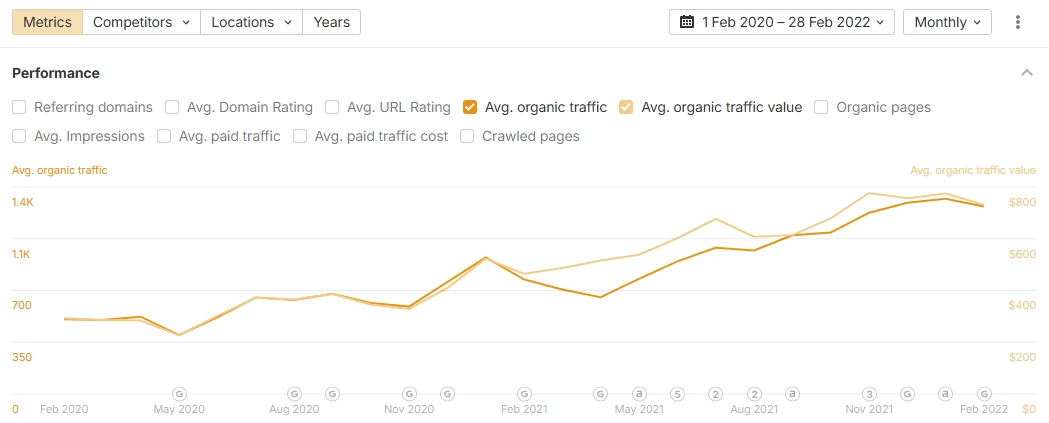
| Est. monthly organic traffic Third-party estimate. | 505 | 1,267 | +150.9% |
| Est. monthly traffic value Third-party estimate, in USD. | $293 | $730 | +149.1% |
| Total ranking keywords | 1,024 | 2,392 | +133.6% |
| Commercial-intent traffic Third-party estimate. | 495 | 1,231 | +148.7% |
| Transactional-intent traffic Third-party estimate. | 493 | 1,164 | +136.1% |
| Top 10 keyword rankings | 505 | 608 | +20.4% |
| Referring domains Fell while traffic more than doubled. | 151 | 123 | -18.5% |
Source: Ahrefs historical data for Google.ca, February 2020 and February 2022. Organic traffic, traffic value, and intent-based traffic are third-party estimates, not analytics figures. Traffic value is the estimated monthly cost of buying the same traffic through paid search.
The catalogue was bigger than its search visibility
The client is an established Canadian awards manufacturer with a physical store, a large product catalogue, and customers across the Greater Toronto Area and the rest of Canada. Its WooCommerce website was not turning that range into matching search visibility.
Page speed was the first problem. Large product images and catalogue assets made pages heavy, and the site generated URLs with no reason to appear in search. Product variations, internal search results, cart pages, and order pages were all being crawled alongside the product and category pages that earned revenue.
The catalogue structure had gaps too. Products spanned many sports, award types, and customer needs, but the site often gave neither Google nor buyers a clear path to the right category. Many product and category pages carried too little content to separate closely related products or to target the searches customers made when they were ready to buy.
The site needed a cleaner crawl path, a stronger catalogue structure, and commercial pages built around how people search for awards.
What changed
The work covered technical SEO, catalogue restructuring, page speed, product and category content, structured data, and link building.
Faster pages without losing product imagery
Customers need to see materials, finishes, and styles before they order an award, so removing images was off the table. I identified the page-weight and image-delivery problems and set requirements for CDN delivery, image compression, and lazy loading. The catalogue got lighter and kept the visual detail buyers rely on.
Crawl and indexation cleanup
I reviewed how Google crawled and indexed product variations, internal search results, cart pages, and order pages, then defined which page types should stay open to search engines and which should be excluded from the index or the crawl path. The goal was to keep Google focused on the product and category pages that could win searches, instead of on URLs WooCommerce generates by default.
Product and category architecture
I rebuilt the relationship between products and categories around the way customers search: by award type, by use, and by sport. A search that pairs a sport with “trophies” now lands on a dedicated category page, instead of asking a single product page or a generic catalogue page to answer it.
The new structure made internal links work harder. Products link up to their parent categories and across to related collections. Google’s guide to ecommerce site structure recommends exactly this pattern of linking from categories to sub-categories to products, and notes that pages with more internal links tend to be treated as more important.
Product and category content for buyer intent
I mapped buyer-intent searches to the relevant product and category pages and set the content requirements for each. Category content explained the range. Product pages covered the details customers compare between awards. Every addition had a commercial purpose, and none of it was filler copy added for length.
The content helped the site move beyond broad industry terms into specific searches for the products it sells.
Custom structured data for the catalogue
WooCommerce provides standard product markup, but the awards catalogue had product details it did not cover. I developed custom schema requirements for the awards and trophy range so those attributes sat alongside the standard markup. Google’s Product structured data documentation explains how this markup lets details such as price and availability appear directly in search results.
Links from relevant local and adjacent sites
Link building focused on sites with a natural connection to awards: local organisations and adjacent industries. I avoided unrelated links chasing authority metrics, and the links supported the domain and the priority commercial pages.
What the numbers show
Estimated organic traffic grew 150.9%, from 505 to 1,267 visits a month. Ranking keywords grew from 1,024 to 2,392.
The growth came from searches with buying intent. Commercial-intent traffic rose 148.7% and transactional-intent traffic rose 136.1%, almost exactly in step with total traffic. By the end of the engagement, the site ranked third on Google.ca for “trophy”, one of the broadest commercial searches in the category, and held strong positions for terms including “custom plaques”, “golf trophies”, “corporate awards”, “custom medals”, “basketball trophies”, “baseball trophies”, and “crystal awards”.
Referring domains went the other way, falling 18.5% from 151 to 123 over the same two years. Traffic more than doubled with fewer linking sites, which points to the on-site work as the main source of growth: a cleaner crawl path, a stronger catalogue structure, pages matched to buyer intent, and better product information. Links supported the programme, but the site grew without a larger link footprint.
If your catalogue has hundreds of products and search visibility does not reflect it, the problem is usually in the crawl path, the category structure, or the content. The paint manufacturer case study shows the same catalogue problems on a B2B site, and how I work sets out the order I fix them in. If you want me to look at your catalogue, book a consult.
Scope
A WooCommerce SEO rebuild covering the crawl path, the catalogue structure, buyer-intent content, structured data and link building.
Covered
- Page speed diagnosis, and requirements for CDN, image compression, and lazy loading.
- Crawl and indexation analysis across product variants, internal search, cart, and order pages.
- Product and category information architecture.
- Buyer-intent keyword research and page mapping.
- Product and category content requirements and briefs.
- Internal link architecture.
- Custom structured data requirements for the awards and trophy catalogue.
- Link building strategy and outreach to relevant local and adjacent-industry sites.
Not covered
- Development work for the CDN, image, indexation, and structured data changes, built by the client's developer from my requirements.
- Final product and category copy, written by a content writer from my briefs and search targets.