
66.5% more search impressions and 21.5% more organic clicks during a real estate SEO rebuild
Dubai real estate agency with a growing team of property agents.
Results
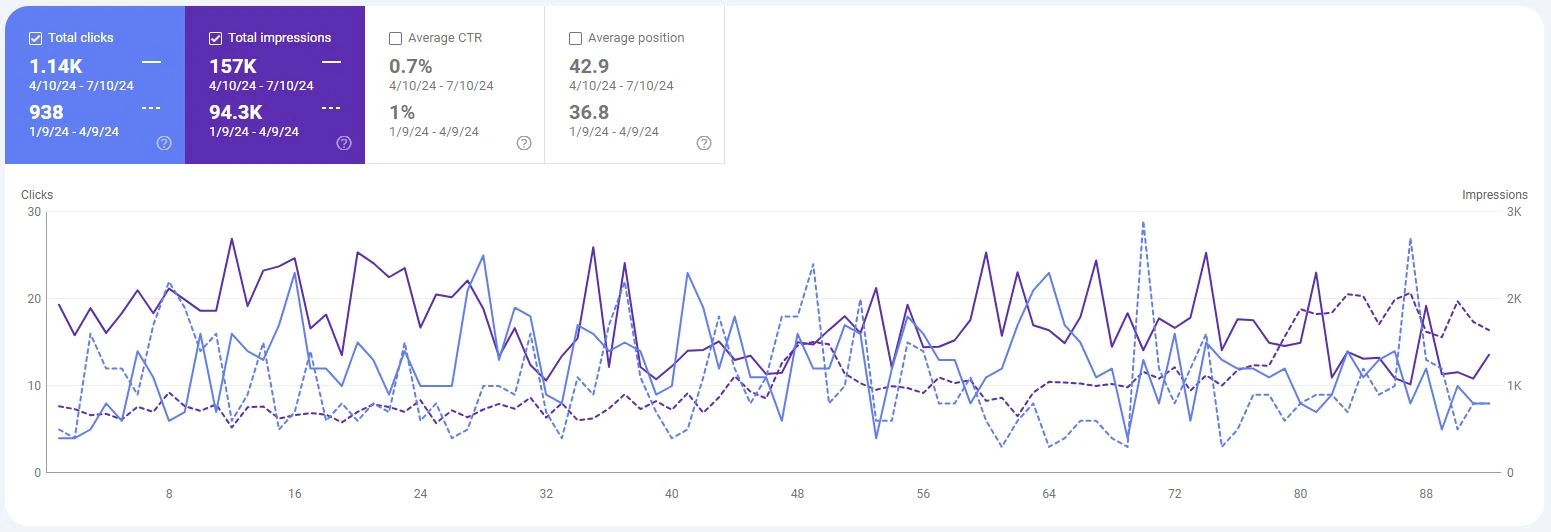
| Metric | Jan to Apr 2024 | Apr to Jul 2024 | Change |
|---|---|---|---|
| Search impressions | 94.3K | 157K | +66.5% |
| Organic clicks | 938 | 1.14K | +21.5% |
| Average CTR | 1.0% | 0.7% | -0.3 pp |
| Average position | 36.8 | 42.9 | Down 6.1 |
Source: Google Search Console Performance report. Periods compared: 9 January to 9 April 2024 and 10 April to 10 July 2024. Search Console rounds figures above 1,000, so percentage changes are calculated from the rounded figures shown. A higher average position number means a lower average ranking.
The website could not support the agency’s SEO plans
I worked with the agency from January to July 2024.
Its website ran on October CMS, which made ongoing SEO and content changes slow and difficult. Over time the site had built up outdated pages, weak internal linking, and URLs that all needed a decision before any rebuild could start.
The website was tied to a live property inventory system. Listings were managed in Bitrix24 and sent out to external property portals, so the migration could not move a set of static pages from one CMS to another and call it done.
Content had gaps too. The site carried property and area information, but it left many of the questions buyers, renters, and overseas investors ask during a property decision unanswered.
The agency’s own people were missing from search entirely. Agents appeared as photos on a team page, and none had a page of their own that Google could connect to their name, experience, or wider online presence.
The project became a full SEO rebuild, well beyond a standard WordPress migration.
What changed
The work covered migration planning, technical SEO, property data integration, site architecture, content, area pages, agent pages, and structured data.
SEO migration planning before development
The move from October CMS to WordPress went live in mid-March 2024.
Before development started, I spent about a month mapping the SEO requirements for the new site: site architecture, content decisions, URL mapping, redirect rules, robots.txt, XML sitemap requirements, and internal link structure. I selected and managed a WordPress developer who could work within those requirements, and the build itself took about two weeks once the mapping was done.
After launch, I ran migration QA and monitored the site for redirect, crawl, and indexation problems.
Rebuild on WordPress
WordPress gave the agency control over landing pages, content, and day-to-day SEO changes.
Every existing page was reviewed before the move. Pages with a clear replacement were mapped to the matching new URL. Pages with no remaining purpose were removed and set to return a 404 or 410, so no old URL was redirected to an unrelated page just to keep it alive. That is the approach Google’s site move documentation recommends, since it warns that redirecting many old URLs to one irrelevant page can be treated as a soft 404.
Property inventory connected to the new site
The website was one part of a wider property technology stack. Bitrix24 ran the inventory workflow and sent listings to external property portals, so the new WordPress site had to keep receiving and displaying that data correctly.
I worked with the Bitrix24 team and the developer to keep listing data flowing into the new site and to make individual property pages manageable. The SEO architecture had to work around a live inventory system, which made the migration harder than a move of static marketing pages.
Search demand mapped to the right pages
I used keyword research to decide what each page should target, so the homepage was no longer expected to rank for every Dubai property search.
I mapped searches across commercial pages, area guides, and supporting content, then set the direction for titles, headings, page copy, and internal links. The mapping showed where a search topic had no suitable page, and where an existing page needed more depth instead of another new URL. Internal links were rebuilt around the new architecture so supporting content pointed to the most relevant commercial and location pages.
Area guides built around property decisions
The existing area guides were generic neighbourhood descriptions. I expanded them around what buyers and renters compare when choosing where to live or invest: nearby schools, hospitals, shopping centres, mosques, and other local amenities.
Each area page became more useful during a real property decision and could rank for a wider range of location searches. The guides gave articles about a particular part of Dubai a strong page to link to.
Content for three property journeys
The content plan followed three search journeys instead of a stream of unrelated real estate articles:
- Buying property in Dubai: the buying process, home valuations, mortgages, property inspections, and practical steps before moving in.
- Renting in Dubai: rental rules, negotiations, maintenance responsibilities, apartment living, and rental disputes.
- Off-plan investment for overseas buyers: the purchase process, regulations, projects, and what investors need to know before entering the Dubai market.
Each article linked to the relevant commercial and area pages, so informational searches led visitors deeper into the site.
14 agent profile pages
Before the rebuild, agents appeared only on the team page, with no URL Google could associate with any individual agent.
I created a structure for 14 agent profile pages. Each agent got an indexable page linked to their active LinkedIn and Instagram profiles. People were already searching for these agents by name, and the pages gave that demand a destination on the agency’s own website, along with more information about the person a prospective client might work with.
Across the comparison periods, searches containing individual agent names grew 786%.
Structured data across the new site
Structured data was part of the rebuilt site’s architecture from the start, covering the organisation, individual agents, breadcrumbs, articles, and property content.
The agent pages mattered most. Their markup connected each agent to the agency and to their profile page, working together with the profile content and links to each agent’s wider professional presence. Google’s ProfilePage documentation names employee pages on a company website as one of the page types this kind of markup is built for.
What the numbers show
The comparison covers January to April 2024 against April to July 2024. The migration went live in mid-March, inside the first period, so the table measures the wider rebuild, not a clean before-and-after of the migration itself. Google’s site move documentation warns that rankings fluctuate temporarily during a move, and part of the first period sits in that window.
Search impressions grew from 94.3K to 157K, up 66.5%. Organic clicks grew from 938 to 1.14K, up 21.5%.
Two averages moved the other way. CTR went from 1.0% to 0.7%, and average position went from 36.8 to 42.9. Both follow from the jump in impressions. As Google’s Performance report documentation explains, average position is calculated across every query a site appears for. The new area guides and articles brought the site into many new searches. New queries usually enter on deeper result pages, which pulls both averages down even as total clicks rise.
The searches that matter most to an agency grew fastest. Query-level data from Search Console showed brand-name searches up 32.21% and searches containing agent names up 786% over the same periods.
If your next website rebuild has to work around live business systems, the SEO requirements need mapping before development starts. The PropTech SaaS migration case study shows the same planning on a domain move, and how I work sets out the order I follow. If you want help scoping a migration, book a consult.
Scope
A full SEO rebuild delivered alongside a CMS migration, scoped before development started rather than after.
Covered
- Migration planning: site architecture, URL mapping, redirect rules, robots.txt, XML sitemap and internal link structure
- Selecting and managing the WordPress developer against those requirements
- Post-launch migration QA, and monitoring for redirect, crawl and indexation problems
- Keyword research mapped to commercial pages, area guides and supporting content
- Area guides rebuilt around property decisions, and content for three buyer journeys
- A structure for 14 agent profile pages
- Structured data for the organisation, agents, breadcrumbs, articles and property content
Not covered
- Building the WordPress site. A developer I selected and managed did the build to the SEO requirements.
- The Bitrix24 property inventory workflow and the feeds to external property portals, which the client Bitrix24 team ran. My part was keeping that data flowing into the new site correctly.