
45.3% more search impressions and 21.4% more organic clicks after a domain migration
North American PropTech SaaS company expanding into a second market.
Results
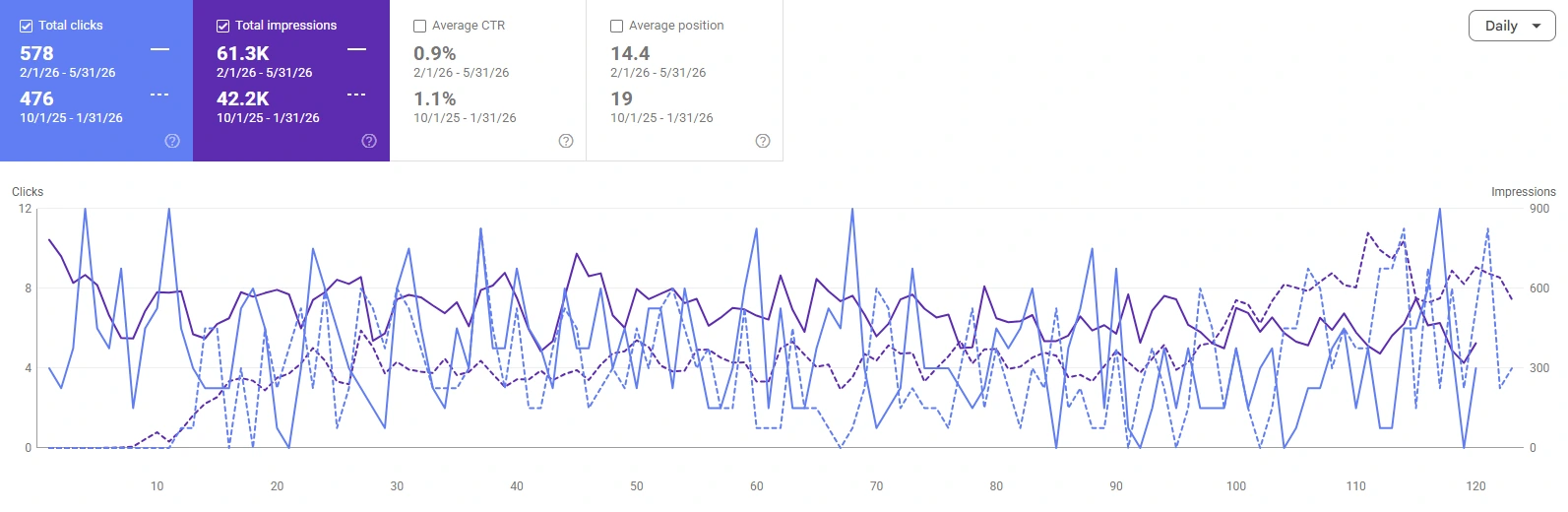
| Metric | Oct 2025 to Jan 2026 | Feb to May 2026 | Change |
|---|---|---|---|
| Organic clicks | 476 | 578 | +21.4% |
| Search impressions | 42,191 | 61,289 | +45.3% |
| Average position | 18.95 | 14.35 | Improved 4.6 |
Source: Google Search Console Performance report. Two equal four-month periods on the new domain: October 2025 to January 2026 and February to May 2026. A lower average position is better, so 18.95 to 14.35 is a gain of 4.6 places.
The country-specific domain no longer fit the growth plan
The client is a North American PropTech SaaS company. Its software launched on a country-specific domain, which made sense while the business served one market. Once expansion into a second market was planned, that domain became a constraint because it strongly signalled a single-country audience.
The product raised a second, less common SEO problem. It sat between several established software categories and did not fit cleanly into any one of them. The words the company used to describe the platform did not match the categories buyers searched for, so keyword research could not start from a category name and work backwards.
The site architecture had gaps too. Some pages used broad product language, and several features and target audiences had no landing page built for search.
The company needed to preserve the visibility it had built in its original market while creating a structure that could support expansion into a second. It also needed search demand mapped to a product with no obvious category.
What changed
The work covered the domain migration, international SEO, on-page work across the site, new landing pages, content, internal linking, and link building.
Migration to a geographically neutral domain
The company chose a geographically neutral domain ahead of its expansion into a second market. I set the SEO requirements for the migration so the old domain passed its search signals to the new one. Every existing URL was mapped to its matching URL on the new domain, with no pages sent to the homepage as a shortcut.
The plan covered a new Search Console property, old and new XML sitemaps, Google’s Change of Address tool, and 404 monitoring after launch. According to Google’s Change of Address documentation, the tool forwards signals from the old site to the new one, and the 301 redirects should stay in place for at least 180 days. The company changed its geographic positioning while protecting the organic visibility it had already built in its original market.
Regional localisation
A new domain fixed only part of the international problem. The original market remained the default site experience, while a second regional version was introduced under a dedicated subdirectory. The regional pages used market-specific terminology and commercial details, including local pricing. They were adapted for the market rather than copied from the default pages.
I specified regional hreflang relationships so search engines could distinguish the intended audience for each version. Each regional page also carried a self-referencing canonical rather than pointing back to the default-market equivalent. The structure leaves room to add more countries or languages later without another migration.
Search demand for a product without a category
With no single obvious keyword to build around, I worked through the platform with the client, feature by feature, and agreed what each part could credibly target. Search demand then set how the homepage, product pages, feature pages, and new landing pages were positioned.
That linked each product capability to a buyer problem and a keyword intent. It kept the site away from high-volume terms that sounded relevant but did not describe what the software does.
On-page work across every commercial page
I reviewed the homepage, product pages, feature pages, and supporting pages, and set the direction for titles, H1s, metadata, copy, and keyword targets. Some fixes were simple. Blog posts had been using a generic site title in place of the article title.
Internal links now connect informational content to the relevant product and commercial pages, and related articles link to each other. Buyers and search engines can follow a subject through the site.
Feature and ICP landing pages
The original architecture gave several features and audiences no page of their own. One broad software page cannot rank for several intents at once. I added feature-led and ICP-led landing pages so each one targets a single capability, problem, or audience. The new pages gave the growing content library stronger destinations for internal links.
12-post topical content sprint
I ran a 12-post content sprint around questions prospective users were already searching. Topics covered the operational and administrative work its users handle day to day, and how to choose software for it.
Each topic sat close to a problem the software helps users manage. Each article links into the relevant product or commercial pages, so the content widened the site’s search footprint and passed authority to the pages that sell.
Authority for the new domain
The off-page campaign supported the migration and the new commercial pages. It included press release distribution, 300 business citations, and three guest posts secured through custom outreach. The guest posts linked to a mix of the homepage and priority inner pages, spreading authority across sections of the new domain.
Measurement from day one
I set up tracking as part of the SEO work, not as an afterthought. Google Search Console and Google Analytics were installed and tested alongside Microsoft Clarity and the Meta Pixel. The new Search Console property mattered most during the migration. It showed how Google was discovering, indexing, and ranking the new domain.
What the migration achieved
A domain migration is usually judged by how much traffic it loses. This one had a harder job. The old country-specific domain reflected a single-market business. The new site had to preserve relevance in the original market while supporting different terminology, pricing, and search behaviour in a second.
Both periods in the table are on the new domain. From October 2025 to January 2026 and then February to May 2026, search impressions rose 45.3% and organic clicks rose 21.4%. Average position improved from 18.95 to 14.35 over the same months. New queries usually enter at deep positions and make the average worse, so a better average alongside 45% more impressions means the site was ranking higher as it appeared in more searches.
The new target market also began appearing meaningfully in Search Console country data, showing that the new domain was gaining visibility beyond the company’s original market.
If you are planning a move into a new market, the domain and URL structure decisions come before any content. How I work sets out the order I follow on B2B SaaS sites. If you want a second opinion on a migration plan, book a consult.
Scope
International SEO programme supporting a North American PropTech SaaS company's domain migration and expansion into a second market.
Covered
- SEO planning for the migration from a country-specific domain to a geographically neutral domain.
- One-to-one URL mapping, redirect requirements, XML sitemap planning, Search Console migration, and post-launch 404 monitoring.
- Regional localisation architecture using market-specific hreflang and self-referencing canonicals.
- Product capability and search-intent mapping.
- On-page optimisation across homepage, product, feature, and supporting commercial pages.
- Feature-led and ICP-led landing-page expansion.
- Internal-link architecture.
- A 12-post topical content sprint.
- Press release distribution, 300 business citations, and three guest posts secured through custom outreach.
- Google Search Console, Google Analytics, Microsoft Clarity, and Meta Pixel setup.
Not covered
- Website development and implementation of the domain migration and localisation changes. The client's in-house developer implemented these from my SEO requirements.