
1,700% more organic enquiries after a four-month technical SEO engagement
Toronto creative agency, corporate and event photography across the GTA.
Results
| Metric | Jul 2023 | Nov 2023 | Change |
|---|---|---|---|
| Organic sessions | 260 | 1,086 | +317.7% |
| Engaged organic sessions | 176 | 759 | +331.3% |
| Organic key event rate | 1.15% | 4.97% | +3.82 pp |
| Average engagement time per organic session | 38 sec | 1 min 2 sec | +63.2% |
| Organic enquiries | 3 | 54 | +1,700% |
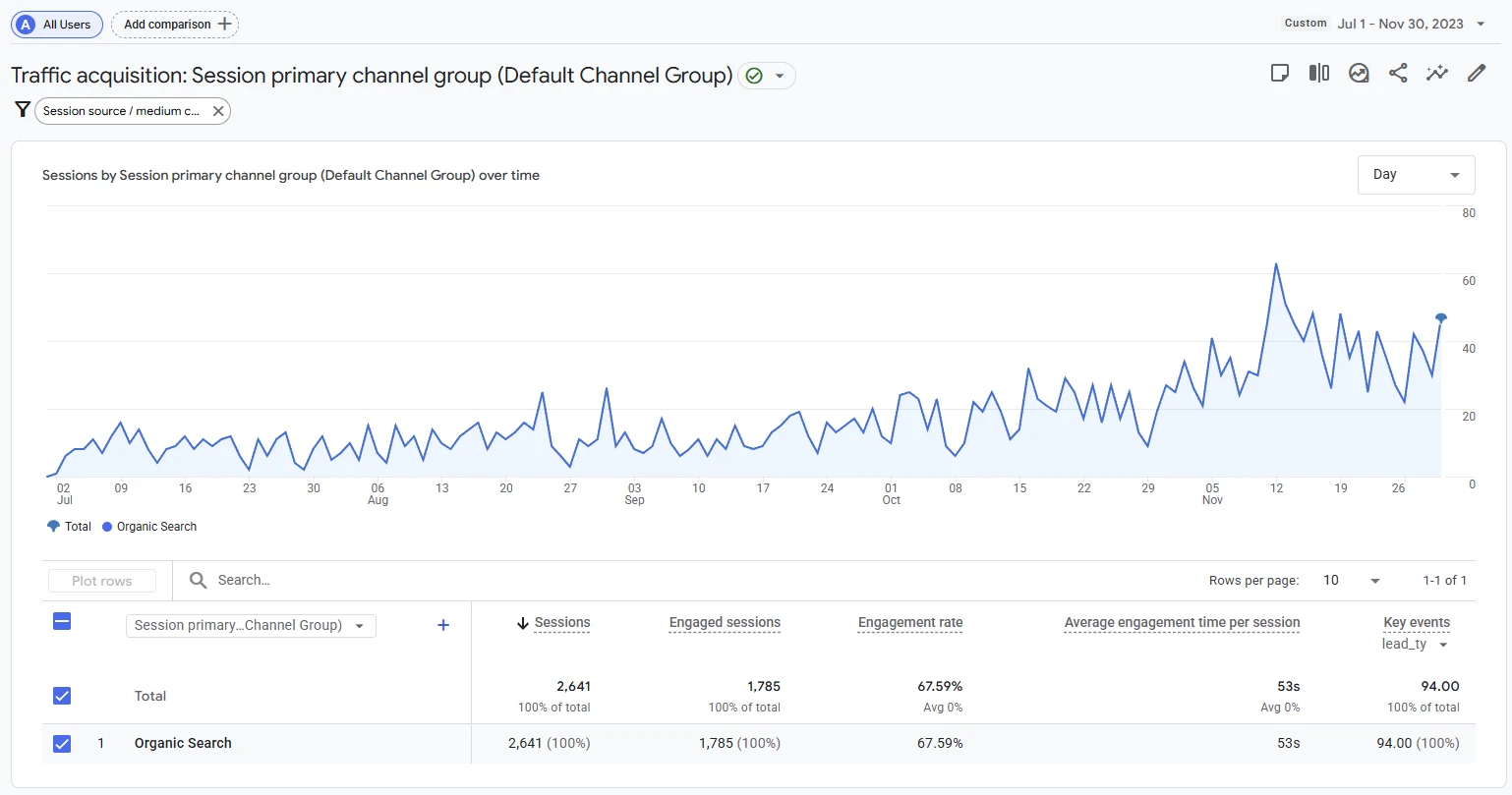
Source: GA4 Traffic acquisition report, filtered to Organic Search. July 2023 is the month before the engagement began and November 2023 is its final month. Enquiries are completed submissions of the site's "Let's Collaborate" form, recorded by the lead_ty key event on the thank-you page. Across the full July to November 2023 period, Organic Search recorded 2,641 sessions and 94 enquiries. The agency's demand is seasonal and rises into the autumn event period, so the comparison shows performance during the engagement, not a controlled test of SEO alone.
A strong-looking website on weak SEO foundations
The client is a Toronto creative agency specialising in corporate photography, event photography, and related production services across the Greater Toronto Area.
Its website showed the work beautifully, and that created one of its biggest technical problems. The WordPress site carried a large volume of high-resolution photography and other rich media. The pages looked impressive, but the media load strained the hosting environment and slowed the site down.
The architecture had gaps too. Many individual service pages sat at the end of the navigation with few or no internal links, and some were orphaned. Search engines could find them, but the site gave weak signals about how they related to the broader service categories.
Category pages and individual service pages sometimes competed for the same searches, and several commercial pages did not match the terms prospective clients used when looking for a photographer or production team.
The work was set up as a short, four-month technical and on-page SEO engagement, with no long-term content programme.
What changed
The engagement covered page performance, internal linking, page targeting, programmatic location and studio pages, structured data, and conversion paths.
Media delivery and page speed
Performance came first. Prospective clients need to see the agency’s work before they enquire, so cutting back the photography was off the table.
Media was offloaded to a CDN to take load off the WordPress environment and speed up asset delivery. I reviewed how the image-heavy pages loaded and where they could lose weight without weakening the portfolio. The aim was to keep the visual quality that sells the agency and remove as much technical friction as possible.
Orphan pages and internal linking
A crawl showed internal linking was one of the site’s weakest areas. Several commercially important service pages had almost no links pointing to them. Google’s guidance on links is direct about this: every page you care about should have a link from at least one other page on your site.
I mapped how the broad service categories related to the individual photography services, then planned and implemented a new internal link structure. Category pages link to their individual services, and each service links back to its category and to related services where the connection makes sense. No priority page is left orphaned, and the commercial structure is clear to users and search engines alike.
Search intent across category and service pages
I mapped each priority page to one defined search intent, instead of spreading broad photography keywords across several URLs. Category pages target the broader service themes, and individual service pages target the narrower commercial searches for each type of photography or production work.
That removed the overlap between pages and gave each URL a clear reason to rank. Category and individual service pages both gained visibility over the four months.
Programmatic pages for nearby service areas
The agency works across Toronto and travels to nearby cities for commercial and event assignments. That opened a local search footprint beyond one city, without pretending the business had offices where it did not.
I built a programmatic location page structure around the nearby areas the agency serves. Each page matches local commercial intent and links back into the main service architecture. Google’s spam policies list pages targeted at specific cities that funnel users to one page as doorway abuse, so the structure was limited to places the agency takes on work, with each page tied to real services.
Programmatic studio pages
A second opportunity came from photography and production studios. Corporate portraits, headshots, product shoots, interviews, and video productions often happen in a rented studio instead of at the client’s office. The agency could supply the photographer or videographer and arrange the studio booking.
I planned pages around studios where the agency could deliver shoots. They target people already researching a particular studio, who may need a photography or video team as well. Outranking the studios for their own names was never the aim. Appearing alongside them put the agency in front of clients who had already reached the point of planning a shoot, through search demand that standard service and location keywords never reach.
Structured data review
I treat technical SEO as unfinished until the structured data has been reviewed alongside crawling, indexation, performance, and architecture. I checked the existing markup and updated it where needed, so it described the business, its services, its content, and its page relationships as the site and business are organised.
Clearer conversion paths
The engagement included a small conversion component. I added clearer calls to action at the right points on priority pages, so visitors arriving from search had an obvious next step. More traffic is worth little if a visitor lands on a service page and has to work out what to do next.
The site’s main enquiry button was “Let’s Collaborate.” Completed form submissions were tracked in GA4 through the lead_ty thank-you page key event, which made enquiries the measure of success, alongside traffic.
What the four months achieved
In July 2023, the month before the work began, Organic Search brought 260 sessions and 3 completed “Let’s Collaborate” enquiries. By November, the final month of the engagement, Organic Search brought 1,086 sessions, up 317.7%, and engaged organic sessions rose from 176 to 759.
The bigger change came after visitors arrived. Enquiries from Organic Search rose from 3 in July to 54 in November. The organic key event rate rose from 1.15% to 4.97%, so a visitor in November was more than four times as likely to enquire as one in July. Average engagement time rose from 38 seconds to 1 minute 2 seconds.
The agency’s demand is seasonal, and traffic normally strengthens as the autumn event period approaches. These results do not claim SEO alone produced every part of the increase. They show the site went into its busiest period with a faster site, a clearer architecture, stronger internal links, wider local coverage, and a clear route from search result to enquiry, and that the extra traffic turned into enquiries the agency could act on.
Why it worked
No single tactic was responsible. The site had several constraints at once: image-heavy pages that loaded slowly, service pages with almost no internal links, category and service pages competing for the same searches, untapped location and studio search demand, unreviewed structured data, and no clear route from landing page to enquiry. The engagement dealt with all of them together.
If a visually strong service website brings in less business than it should, look at performance, architecture, page intent, and conversion paths before commissioning more content. How I work sets out the order I follow. If you want me to look at your site, book a consult.
Scope
A four-month technical and on-page SEO engagement covering performance, crawl and indexation, internal link architecture, page intent, programmatic location and studio pages, structured data, and conversion paths. No content programme.
Covered
- Technical SEO audit and prioritisation.
- WordPress performance review, with CDN and media delivery requirements for an image-heavy portfolio site.
- Crawl and indexation review.
- Orphan page fixes and a new internal link architecture across category and service pages.
- Intent mapping and on-page work, one defined search intent per priority page.
- Programmatic location page architecture for the nearby areas the agency serves.
- Programmatic studio page strategy.
- Structured data review and schema requirements.
- Call-to-action placement on priority pages.
- GA4 measurement of the enquiry form through the lead_ty key event.
Not covered
- Website redesign and creative direction.
- Photography, video production, and portfolio assets.
- Long-term content publishing. This was a four-month technical engagement with no content programme.
- Paid advertising.
- Proof that SEO alone caused the increase. The agency's demand is seasonal and rises into the autumn event period, so the comparison shows performance during the engagement, not a controlled test.