
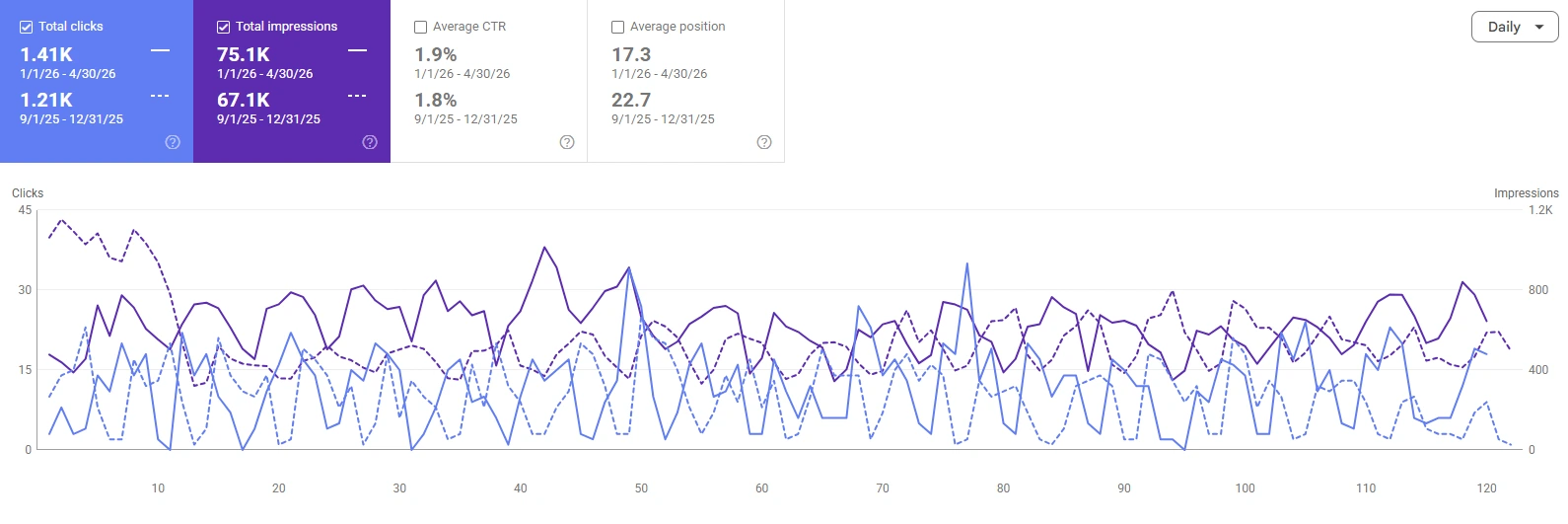
16.5% more organic clicks as average position improves by 5.4 positions
Global B2B thermal engineering company serving industrial manufacturers.
Results
| Metric | Sep to Dec 2025 | Jan to Apr 2026 | Change |
|---|---|---|---|
| Organic clicks | 1.21K | 1.41K | +16.5% |
| Search impressions | 67.1K | 75.1K | +11.9% |
| Average CTR | 1.8% | 1.9% | +0.1 pp |
| Average position | 22.7 | 17.3 | Improved 5.4 |
Source: Google Search Console Performance report. Periods compared: September to December 2025 and January to April 2026. A lower average position is better, so 22.7 to 17.3 is a gain of 5.4 places across the full query set for the site.
The site did not match how engineers search
The client designs and manufactures thermal engineering solutions for industrial manufacturers worldwide. Its buyers are engineers, and engineers seldom search for a broad product category. They search by application, by manufacturing process, by an engineering requirement, or by the exact component they need.
The site was organised around the product range instead. Some commercial landing pages were too thin to compete, related product categories competed for the same search intent, and several applications with clear search demand had no page of their own.
One temperature-sensing page made the mismatch easy to see. It presented two related product types together, and Google was returning separate results for each one. Links could raise that page’s authority. They could not fix a page built for one intent when the SERP showed two.
Technical debt sat underneath. The site had duplicate URLs, legacy pages that needed redirects, incomplete sections, plugin-generated URLs, and crawl paths with no search value. Internal links did little to connect the technical content to the product, application, and service pages meant to rank.
The company had the engineering knowledge. The website did not present it the way engineers research a problem.
What changed
The engagement started in March 2025 and is still running. Technical cleanup and page performance came first, then search intent, site architecture, internal linking, technical content, and structured data.
Page speed
The site depends on technical diagrams, product drawings, and engineering visuals. Engineers need those assets, so cutting them to reduce page weight was off the table. I traced part of the performance problem to image delivery and worked with the developer on a CDN and image handling.
Crawl, redirects, and indexation
Over the years the site had built up duplicate pages, incomplete URLs, legacy content, and plugin-generated pages with no reason to appear in search. I mapped the affected URLs, decided which pages to consolidate or remove, and specified the redirect and indexation requirements for the developer. That covered legacy URL mapping, 301 redirects, XML sitemap coverage, and the low-value crawl paths created by plugins.
On-page targeting and internal linking
I reviewed the priority product, application, and service pages and set the direction for titles, headings, metadata, page content, and internal links. Pages already close to page one got the most attention. Where Google treated related technical topics as separate searches, the page plan followed the SERP instead of forcing two intents onto one URL.
Industry and application landing pages
Broad industry pages missed most of the search demand. I built the content architecture around industry and application pairs, so each page covers the manufacturing process or thermal problem an engineer is trying to solve.
- Aerospace and defence
- Plastic injection
- Rubber moulding
- Electronics cooling
- Composite tooling
- Industrial casting
- Filament winding
- Plastic welding
- Packaging and sealing
- Pultrusion
75+ term technical glossary
I planned a glossary of more than 75 industry terms built around the site’s main keyword themes. Each entry links to the relevant product, application, or commercial page, and related terms link to each other. The glossary picks up technical searches earlier in an engineer’s research and adds another layer of internal links back to the commercial pages.
16-post engineer-reviewed content sprint
I ran a four-month content sprint of 16 in-depth technical articles, published at roughly four a month. Each topic was mapped to an existing product, application, or industry silo, so no article sat on its own as an isolated blog post. Topics covered industrial thermal management, plastic injection, rubber moulding, electronics cooling, composite tooling, aerospace and defence, industrial casting, temperature sensing, packaging, and pultrusion.
The client’s engineers reviewed every article before it went live. Their input added first-hand technical detail and kept the content accurate for a reader who would spot a mistake straight away. Each article was then linked into the relevant product, application, and commercial pages.
Custom schema and Wikidata entities
I developed custom structured data using about, mentions, sameAs, and knowsAbout, pointing to a Wikidata entity wherever a close and relevant one existed. The markup ties each page’s topic, and the company’s areas of knowledge, to entities search engines already recognise.
Why average position is the number to watch
A technical B2B site rarely depends on one high-volume keyword. Search demand is spread across products, applications, manufacturing processes, engineering problems, and technical terms.
In Search Console, average position takes the site’s topmost position for each query and averages it across every query the site appeared for, as Google’s Performance report documentation explains. New queries usually enter at deep positions, so a site that starts showing up for more searches often sees its average position get worse first. Here impressions rose 11.9% and average position still improved, from 22.7 to 17.3. The site was showing up for more searches and ranking higher across them at the same time.
Clicks followed, up 16.5%, with CTR moving from 1.8% to 1.9%. Both periods fall inside an engagement that started in March 2025, so the table shows continued progress, not a jump from a pre-SEO baseline. Thermal engineering searches drop over the holidays when most industrial businesses are on break, and that break falls across both periods: late December in the first, early January in the second.
If your site is a large technical catalogue and your buyers search by application rather than product name, that gap is usually where rankings stall. The paint manufacturer case study shows the same problem in a different industry, and how I work sets out the order I fix it in. If you want me to look at your site, book a consult.
Scope
SEO strategy covering technical cleanup, search-intent architecture, topical expansion, internal linking, and structured data for a global engineering website.
Covered
- Page-speed diagnosis and CDN and image-delivery recommendations.
- Duplicate URL, legacy URL, redirect, crawl, sitemap, and indexation planning.
- On-page targeting across priority product, application, and service pages.
- Industry and application landing-page architecture.
- Planning and internal-linking architecture for a 75+ term technical glossary.
- A four-month, 16-post technical content sprint.
- Custom structured data using about, mentions, sameAs, knowsAbout, and relevant Wikidata entities.
Not covered
- Hands-on development implementation of CDN, image-handling, redirect, and indexation changes. The client's developer implemented the technical requirements.
- Final engineering subject-matter validation. The client's engineers reviewed every technical article before publication.