

Cybersecurity is the most crowded, highest-stakes B2B SEO category I work in. Buyers are technical, sales cycles are long, trust signals matter more than clever copy, and by 2026, the entire game changed again because CISOs started researching vendors with ChatGPT before they ever opened a Google tab.
This guide is the implementation framework I use for security vendors, MSSPs, and managed security services firms. It covers traditional search, AI visibility, and the places where the two overlap.
It’s not a beginner’s introduction to SEO. If you want that, there are a thousand posts online. This is the actual playbook for a category where your buyers have compliance requirements, technical scrutiny, and growing reasons to skip your website entirely.
The 2026 reality for cybersecurity SEO
Two things changed in the last twelve months that break most pre-2025 SEO playbooks for this category.
First, AI search adoption in B2B hit critical mass. 73% of B2B buyers now use AI tools like ChatGPT and Perplexity in their research process (Averi, March 2026). For cybersecurity specifically, 58% of B2B technology buyers use AI-powered search in their initial vendor research phase, up from 17% in 2023 (Katalysts, 2026).
Second, most cybersecurity vendors aren’t showing up there at all. GrackerAI’s February 2026 benchmark tested 100 cybersecurity vendors across 10 sub-categories (EDR, SIEM, Zero Trust/SASE, IAM, Cloud Security, Email Security, Vulnerability Management, MDR, DLP, and Network Security). Their finding: 73% of cybersecurity vendors tested received zero citations from ChatGPT when buyers asked for vendor recommendations in their category (GrackerAI, February 2026). The same study found an enterprise cybersecurity firm with 50,000+ monthly Google visitors receiving zero ChatGPT citations, while a competitor with a fraction of their organic traffic appeared consistently.
The implication is clear. Traditional SEO rankings no longer predict AI visibility. You can rank page one in Google and be completely absent from ChatGPT, Perplexity, and Gemini for the same buyer query.
Practitioner note: When I audit a cybersecurity vendor, the first check now is how they show up in AI answers, not where they rank in Google. Google rankings and AI citations have decoupled. Most 2025-era SEO work ignored the AI layer entirely, which is why so many vendors with strong organic traffic are suddenly losing deals they didn’t know they were in.
Why cybersecurity SEO is different
Before the tactical framework, worth naming what makes this category genuinely harder than generic B2B SEO.
Buyers are technical and skeptical. CISOs, security architects, and IT directors won’t forgive weak technical content. They’ll catch fake certifications, wrong CVE references, and lazy compliance claims in a paragraph. A generic SEO agency trying to “elevate” a cybersecurity brand with marketing fluff gets found out on the first page.
Sales cycles are long and multi-stakeholder. A single enterprise security deal might involve a CISO, VP of IT, security architect, procurement, and finance. Different people search different things. Your content needs to serve all of them without turning into a content farm.
Compliance content is a ranking asset, not a legal obligation. HIPAA, SOC 2, PCI-DSS, ISO 27001, NIST, and newer AI-specific frameworks like the EU AI Act create high-intent search opportunities most generalist SEO writers don’t recognize.
Trust signals matter more than backlinks. In categories where buyers evaluate vendors based on track record and certifications, brand entity signals and third-party validation drive both search rankings and AI citations more than raw backlink volume.
The incumbent authority problem. Search results for core cybersecurity queries are dominated by Gartner, CISA, Verizon DBIR, CrowdStrike, Palo Alto Networks, and big vendor blogs. Ranking next to these requires more than good content. It requires topical authority, genuine expertise signals, and citation work.
The global cybersecurity market in 2026
For context on what you’re competing for:
- Worldwide end-user spending on information security is projected to reach $240 billion in 2026, up from $213 billion in 2025 and $193 billion in 2024 (Gartner, 2025)
- End-user spending on cybersecurity services alone will hit $121.1 billion in 2026, up from $106 billion in 2025 (Gartner, 2025)
- Managed security services is the fastest-growing subsegment in many markets, with MDR and other managed services seeing 15%+ growth rates (Gartner, March 2026)
- 93% of security buyers prefer platform-based security purchases in 2026, up from 87% in 2025 (Kiteworks, February 2026)
Translation: bigger market, more buyers, shift toward platforms and managed services, and harder differentiation. SEO is how you earn the shortlist spot before the RFP process even starts.
The two-pillar framework
I run cybersecurity SEO consulting through two parallel pillars. Both matter. Neither works alone in 2026.
Pillar 1: Search visibility
Traditional SEO work, adapted for cybersecurity’s specific buyer behaviour and trust requirements.
This pillar covers:
- Technical SEO foundation (HTTPS, schema, Core Web Vitals, crawlability)
- Buyer-intent commercial pages (MDR, SIEM, XDR, IAM service pages)
- Topical authority content (compliance guides, threat research, category education)
- Internal linking architecture that moves authority to commercial pages
- Entity and brand consolidation across the web
Pillar 2: AI visibility
Getting cited by ChatGPT, Perplexity, Gemini, Google AI Overviews, and Copilot when buyers ask cybersecurity questions.
This pillar covers:
- Entity presence across Wikidata, Wikipedia, Crunchbase, G2, Capterra
- Schema markup designed for AI consumption (Organization, Product, FAQPage, Article)
- LLM.txt and robots directives for AI crawlers
- Third-party citation engineering (reviews, analyst mentions, earned media)
- AI citation tracking and measurement
The reason to run both: 73% of B2B buyers use AI tools to research vendors, but traditional Google search still drives the majority of verified conversion traffic. Your buyers are moving between both channels in a single session. If you’re missing in either, you lose the deal.
What moves the needle for AI visibility in cybersecurity
Specific patterns the research is showing for 2026:
Brand mentions and entity recognition matter more than backlinks. The Digital Bloom’s analysis identified brand search volume as the strongest predictor of AI citations, with a 0.334 correlation coefficient (via Ekamoira, January 2026). Backlinks show weak or neutral correlation with LLM visibility.
Review platforms drive 3x higher ChatGPT citation rates. Domains with profiles on Trustpilot, G2, Capterra, and similar review platforms have 3x higher chances of being cited by ChatGPT compared to sites without such presence (SE Ranking, November 2025). For cybersecurity vendors, this means active, current profiles on G2 (especially) and Capterra. Abandoned review pages are worse than none.
Each AI platform cites different sources. Only 11% of domains are cited by both ChatGPT and Perplexity (Averi, 2026). ChatGPT favours Wikipedia and encyclopedic content (47.9% of top citations). Perplexity heavily cites Reddit (46.7%). Google AI Overviews prefer YouTube and multi-modal content (23.3%). You can’t optimize for one and expect coverage across all three.
Domain age and authority still matter. Average domain age of ChatGPT-cited sources is 17 years (Ekamoira, 2026). Sites with over 32,000 referring domains are 3.5x more likely to be cited than sites with under 200 referring domains (SE Ranking, November 2025). Brand-new cybersecurity startups face an entity-age problem that takes real work to solve.
List-based content gets cited disproportionately. Listicles account for 21.9% of all citations in AI Mode, ChatGPT, and Perplexity, followed by articles at 16.7% and product pages at 13.7% (Growth Memo, via Position.digital, 2026). Top cybersecurity vendors are building dedicated comparison and listicle pages specifically to capture this citation behaviour (Concurate, March 2026).
Practitioner note: The review platform finding is the most actionable single move for most cybersecurity vendors I audit. Most have a G2 profile that hasn’t been updated in 18 months, a Capterra listing with no case studies, and zero presence on Trustpilot. Fixing that is a two-week project that can meaningfully change AI citation patterns. It’s not glamorous. It works.
The search visibility framework
Now the traditional SEO pillar. Most of this applies across B2B but the examples are cybersecurity-specific.
Technical foundation
Google still rewards fast, secure, well-structured sites. For cybersecurity vendors, technical credibility is doubly important because your buyers can see poor technical implementation immediately.
Things to get right:
- HTTPS everywhere with current SSL certificates. A security vendor with expired SSL is an immediate credibility loss
- Schema markup for commercial pages. Use Organization, Service, Product, FAQPage, and Review schema on service pages. AI engines parse these directly when extracting citations
- Core Web Vitals compliance. LCP under 2.5s, CLS under 0.1, INP under 200ms. Security product pages often fail because they load heavy chat widgets, tracking pixels, and tag managers
- Crawl accessibility for AI engines. Check that your robots.txt doesn’t accidentally block OAI-SearchBot, PerplexityBot, or ClaudeBot. Many cybersecurity companies block these by default and lose AI visibility without realising
Buyer-intent commercial pages
The pages that actually drive pipeline. For cybersecurity, the mistake most vendors make is writing one “cybersecurity services” page and expecting it to rank for everything. It doesn’t.
Build dedicated commercial pages for:
- Each service you sell (MDR, SIEM, XDR, IAM, MSSP, vCISO, SOC as a Service, etc.)
- Each compliance framework you support (HIPAA, SOC 2, PCI-DSS, ISO 27001, FedRAMP, DPDP Act)
- Each industry vertical you serve (healthcare, finance, manufacturing, legal, education)
- Service x industry combinations where you have proof (for example, “MDR for healthcare” or “SOC 2 for SaaS”)
When I managed SEO for a Canadian MSP specialising in cybersecurity, we saw 15x keyword growth in 18 months by building this commercial page architecture around MDR, UTM, and next-generation firewalls, each targeting distinct buyer personas. The full approach is in the MSP SEO case study.
Topical authority content
Commercial pages rank faster when the surrounding content demonstrates expertise. Cybersecurity is a category where this is especially important because Google’s algorithms and AI engines both weight topical depth heavily for trust-sensitive categories.
Build clusters around:
- Compliance frameworks – deep educational content on what each framework requires, how organizations prepare, and how to evaluate vendors against them
- Threat categories – ransomware, supply chain attacks, AI-driven social engineering, identity-based attacks
- Specific incidents and CVEs – cybersecurity buyers search for specific CVE numbers when they’re triaging vulnerabilities. Pages that rank for these get high-intent traffic
- Technology category primers – what is XDR, what is CNAPP, what is IAM, etc. The “what is” content still matters, it just doesn’t convert directly. It builds category authority that makes your commercial pages rank
Internal linking architecture
Most cybersecurity sites have a messy internal linking structure that treats the blog as an island. This wastes authority.
The pattern I use:
- Commercial pages get internal links from every topically relevant blog post
- Compliance pages link to the service pages that deliver on that compliance
- Category primer pages link to commercial pages that sell the thing the primer explains
- Every page links back to the main services hub
The goal is to move page-level authority toward the commercial pages that actually convert.
Buyer persona alignment
Cybersecurity solutions serve different personas with different search behaviours.
MDR services – CISOs and IT directors search for proactive threat detection, 24/7 SOC monitoring, incident response capabilities, and compliance alignment. Content should lead with response times, SLAs, and analyst credentials.
SIEM and log management – Security architects and SOC analysts search for specific integrations, log ingestion capacity, correlation rule flexibility, and total cost of ownership. Content should be technical and spec-heavy.
UTM and firewall solutions – SMB owners and IT managers look for cost-efficient bundles that consolidate firewall, intrusion prevention, antivirus, and content filtering. Content should lead with consolidation benefits and total cost.
Zero Trust / SASE – Enterprise architects and VPs of security look for architecture clarity, integration with existing identity providers, and migration paths from legacy VPN. Content should include reference architectures and migration frameworks.
Identity and Access Management (IAM) – Identity architects and IT directors search for specific protocols (SAML, OAuth, SCIM), privileged access workflows, and Zero Trust alignment. Content should be standards-heavy.
Each persona needs dedicated landing pages. One cybersecurity services page trying to serve all five fails at all five.
Compliance content is the highest-ROI topical authority in 2026
This is the single biggest underexploited content opportunity in cybersecurity SEO.
Why it works:
- High intent (searchers with compliance deadlines buy faster)
- Lower competition than broad cybersecurity queries
- Strong internal link potential (compliance content naturally links to service pages)
- Excellent AI citation magnet (LLMs cite compliance content heavily when users ask “HIPAA MDR” style questions)
The structure I recommend:
- Top-funnel: Educational content about each compliance framework (“What is SOC 2 Type II”, “HIPAA technical safeguards explained”)
- Mid-funnel: Comparison and decision content (“HIPAA-compliant MDR solutions”, “ISO 27001 vs SOC 2 for SaaS companies”, “How to choose a PCI-DSS compliant MSSP”)
- Bottom-funnel: Solution pages that explicitly state compliance alignment (“Our SOC 2 Type II certified managed SOC service”)
Industries like healthcare, retail, hospitality, financial services, and education actively search for compliance-specific cybersecurity vendors. These are lower-competition, high-intent keyword clusters that most vendors underinvest in.
Measuring success in 2026
Traditional SEO metrics don’t capture the AI visibility layer. Here’s the metrics framework I use:
Search visibility metrics
- Rankings for buyer-intent commercial keywords (not branded, not informational)
- Organic traffic to commercial pages (service, comparison, compliance)
- Qualified conversions from organic (demo requests, contact forms, case study downloads)
- Featured snippet and People Also Ask presence
AI visibility metrics
- Citation frequency across platforms – how often your brand appears when buyers run 20-30 defined category queries across ChatGPT, Perplexity, Gemini, and Copilot
- Position within AI responses – first mention, middle, or end of the answer
- Citation accuracy – whether the AI describes you correctly or conflates you with competitors
- Share of voice – your citation frequency compared to your top three competitors
- Query-level gaps -which specific buyer queries return zero citations for you
Authority metrics
- Brand search volume trend (strongest predictor of AI citations per 2026 research)
- Review platform presence and currency (G2, Capterra, Trustpilot)
- Earned media coverage in cybersecurity publications
- Analyst mentions and reports (Gartner, Forrester, IDC)
Practitioner note: Most cybersecurity marketing teams I work with have no AI visibility tracking at all. I set up a GA4 report for AI citation data and run manual queries monthly. It’s not automated and it’s not perfect, but it’s the baseline every cybersecurity vendor should have. Without it, you’re flying blind on 58% of your buyers’ research behaviour.
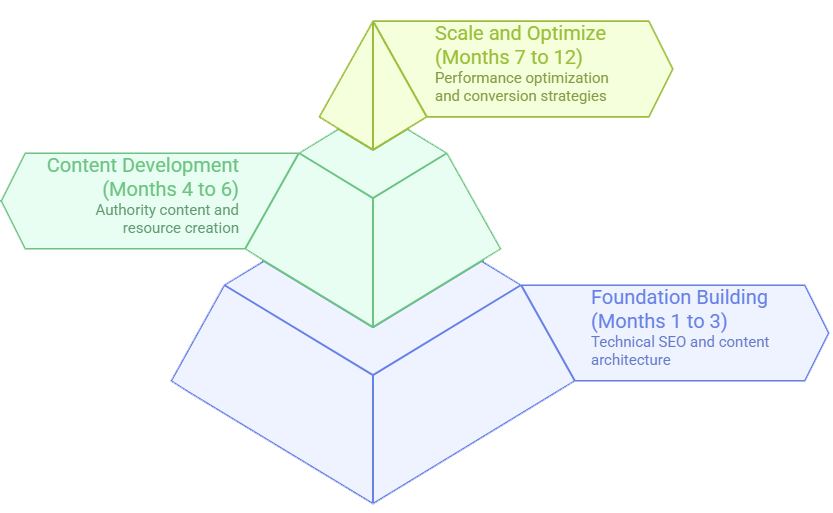
Implementation timeline
Based on what I see across cybersecurity engagements:
| Phase | Duration | Key Activities | Expected Outcomes |
|---|---|---|---|
| Foundation Building | Months 1-3 | Technical SEO implementation, Content architecture development, Initial keyword targeting | 25-40% improvement in technical scores |
| Content Development | Months 4-6 | Authority-building content creation, Technical resource development, Industry-specific optimization | 2-3x increase in qualified traffic |
| Scale and Optimize | Months 7-12 | Performance optimization, Advanced content strategies, Conversion rate improvements | 5-10x improvement in lead quality |
Cybersecurity SEO tends to show accelerated results compared to some B2B categories because the content competition on specific technical queries is lower than in generalist SaaS or ecommerce. Compliance content especially compounds fast.
SEO Growth Strategy Pyramid
Common mistakes I see
Mistake 1: Writing for CISOs exclusively. Most buying committees include three to five people. The CISO reads your thought leadership. The procurement lead checks your compliance certifications. The security architect reviews your technical documentation. Each needs different content.
Mistake 2: Treating AI visibility as a separate project. The vendors getting cited by AI engines in 2026 aren’t running parallel “AI SEO” campaigns. They’re integrating AI visibility work into everything they do. Schema, entity consolidation, and structured content benefit both Google rankings and AI citations.
Mistake 3: Ignoring review platforms. This one frustrates me the most. G2, Capterra, and Trustpilot drive disproportionate AI citation rates. Most cybersecurity vendors have one-time profile setups from years ago and no ongoing review acquisition strategy. Fixing this is a two-week project that moves real metrics.
Mistake 4: Generic compliance content. “We support HIPAA” in a bullet list doesn’t rank. “How our MDR service meets HIPAA technical safeguard requirements for healthcare providers” does, and it gets cited by AI engines when users ask specific questions.
Mistake 5: Not tracking AI visibility at all. If you don’t know whether ChatGPT, Perplexity, and Gemini are citing you for your category queries, you’re managing a channel you can’t see. Even a basic monthly manual check is better than nothing.
Where this all ties together
Cybersecurity SEO in 2026 works when you run both pillars together. Traditional search visibility still drives most of your verified conversion traffic. AI visibility is where your buyers are increasingly researching you first.
The overlap between the two is bigger than it looks. Good schema helps both. Entity consolidation helps both. Strong brand mentions across Reddit, G2, and industry publications help both. The work isn’t different. The measurement and the definition of “winning” is what changed.
If you’re an MSSP or cybersecurity vendor thinking through what to do about this, I cover the full combined approach on my MSSP SEO consultant page, and the industries I work with across security, SaaS, and B2B tech are listed on who I help.
For the broader data on how AI search is reshaping B2B visibility, I’ve compiled the latest citation patterns and buyer research data in my AI search statistics guide.
The short version
Cybersecurity SEO in 2026 is two jobs, not one. You need to be ranked in Google for buyer-intent queries, and you need to be cited by ChatGPT, Perplexity, and Gemini when your buyers ask for vendor recommendations. Most vendors are still only doing one. That’s the opportunity.
If you want to see where your cybersecurity brand stands in AI and search today, the $397 AI Visibility Spot-Check gives you a ranked list of fixes in five business days. No sales call required.