
CYBERSECURITY SEO Consultant
Get Your Cybersecurity Brand Cited in AI Answers and Ranked for Category-Defining Searches
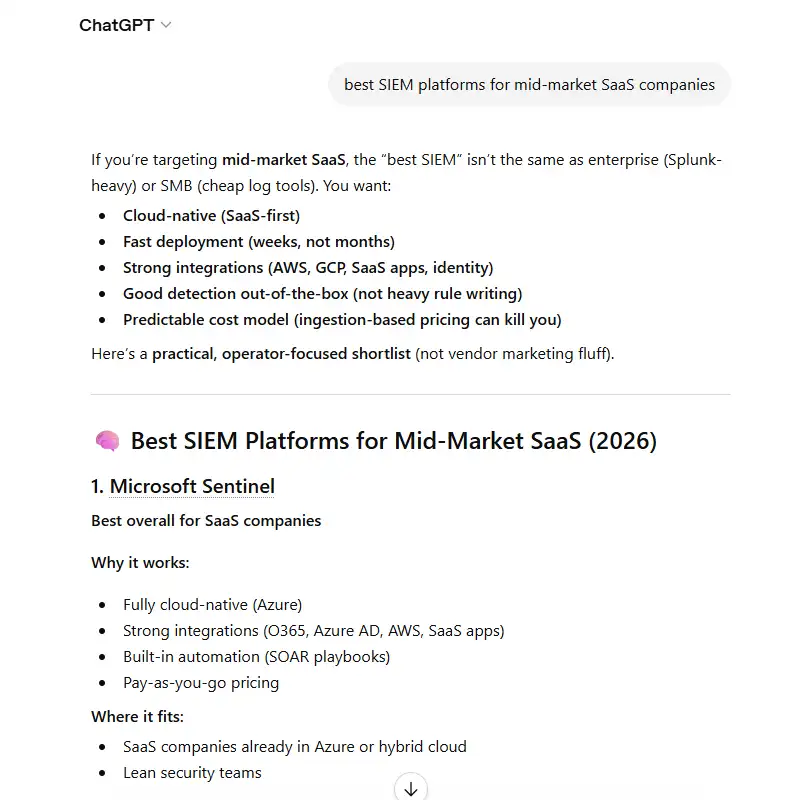
Your buyers ask ChatGPT, Perplexity and Gemini to compare cybersecurity vendors before they ever check Gartner. If you’re missing in those answers, you’re not on the shortlist. I fix your AI visibility and your search rankings together, so the right buyers find you first.
THE GAP
Why cybersecurity vendors lose deals before the demo
Cybersecurity buyers research differently from other B2B categories. They cross-check three or four AI engines, validate against Gartner and Forrester, and only then consider a vendor demo. If your brand isn’t visible in any of those layers, you’re losing pipeline you’ll never see in your CRM. These are the three failure points I see most often when cybersecurity vendors audit why their organic numbers aren’t translating to demo requests.
ANALYST PARITY GAP
AI engines cite the analysts, not you
When a CISO asks ChatGPT for the top XDR vendors, the answer pulls from Gartner Magic Quadrant write-ups, Forrester Wave reports, and incumbent vendor blogs. Your category positioning never gets surfaced because AI engines treat analyst content as the canonical source. According to GrackerAI’s February 2026 cybersecurity benchmark, 73% of cybersecurity vendors tested received zero citations from ChatGPT when buyers asked for vendor recommendations in their category. Entity work and citation engineering close that gap.
CATEGORY DILUTION
Your category page ranks below every think piece written about it
“What is XDR” content from CrowdStrike, Microsoft, and Palo Alto sits in positions one through five. Your XDR product page is on page two. Buyers researching the category never reach you, even though they land on a query you should own. This is the structural problem with cybersecurity SEO: incumbent vendors and analyst sites have eaten the educational layer, leaving product pages competing for whatever ranking opportunity remains.
TRUST DEFICIT
Your product is real. Your brand entity isn’t.
You have working detection, real customers, and meaningful capabilities. AI engines don’t know any of that. They see scattered signals across your homepage, a Crunchbase profile from 2022, and a G2 page with three reviews. That fragmented entity is why ChatGPT describes you incorrectly or skips you entirely when someone asks about your category. Fixing this is methodical and unglamorous, and it’s the highest-leverage work I do for new cybersecurity vendor clients.
THE FIX
Two services, one outcome: you get found
AI Visibility
Search Visibility
See where you stand in 5 days
The $397 spot-check delivers five prioritised fixes with no sales call attached.
THE PROOF
The kind of results I aim for with cybersecurity clients
None of these case studies are from cybersecurity vendors specifically, but each one tested a methodology I now apply when cybersecurity clients bring me in. The MSP work proved out the topical authority approach that wins for cybersecurity verticals. The Copilot citation work is the live system behind the AI visibility methodology. The B2B manufacturer’s traffic growth came from the same long-tail commercial-page architecture that cybersecurity vendors need for their category and comparison pages.
B2B MSP
15x keyword growth in 18 months
A Canadian MSP serving healthcare and finance verticals built systematic topical authority around managed services and threat detection. The same content architecture works for cybersecurity vendors building authority on attack categories, compliance frameworks, and category-defining technical content.
AI VISIBILITY
17,900+ Microsoft Copilot citations in 90 days
A niche site I built and run as a live test bed for the citation engineering methodology I deploy with cybersecurity vendor clients. Publicly trackable proof that entity consolidation, schema deployment, and citation paths produce AI visibility for categories where vendors are otherwise invisible. The same system runs underneath every cybersecurity AI visibility engagement.
B2B MANUFACTURING
517% non-branded traffic in 14 months
A B2B metal fabricator ranking for technical long-tail buyer queries through commercial-intent pages and topical authority on industry terminology. The same architecture wins for cybersecurity vendors competing on category pages, comparison pages, and product-specific evaluation queries where buyers compare three or four vendors before requesting a demo.
WHY ME
Why cybersecurity vendors hire me to run both pillars

Cybersecurity category fluency
Fifteen years of B2B SEO work, with focus across cybersecurity, MSP, SaaS, and industrial. I know the difference between content that ranks for “endpoint security” and content that ranks for “endpoint protection platform with EDR for healthcare.” One drives traffic. The other drives evaluation requests.
Every algorithm shift since 2010
That includes Panda, Penguin, Medic, HCU, and the AI-search transition that’s reshaping how cybersecurity vendors get found. What works long-term is methodology, not tactics. That’s what I bring to every cybersecurity vendor engagement.
You work with me, not a team
No account manager, no junior strategist, no handoff. The person scoping your AI visibility audit is the same person writing your category page strategy and reviewing your schema implementation. Senior consultant decisions on every line item, applied to a category that punishes generic SEO playbooks.
QUESTIONS
Questions cybersecurity vendors ask before working with me
What’s included in the $397 AI Visibility Spot-Check?
You get an entity audit across Wikidata, Wikipedia, Crunchbase, G2, Capterra, and your top analyst sources, a schema review of your top ten commercial pages, AI visibility testing across ChatGPT, Perplexity, Gemini, and Copilot for five agreed category queries, a competitor citation gap, and the top five prioritised fixes ranked by effort and impact. Delivered as a Loom walkthrough and PDF report in five business days. No live call required.
How do you measure AI visibility? It doesn’t show up in Google Analytics?
GA4 doesn’t report AI citation data, so if you give me access, I’ll set up an AI visibility report inside your existing GA4 property. I run defined queries across ChatGPT, Perplexity, Gemini, and Copilot tied to your category buyer intent — for example, “best XDR for healthcare” or “endpoint protection vendors for SaaS.” For each query I log which engines cite you, which cite competitors, which describe you incorrectly, and which conflate you with adjacent vendors. The baseline is captured before any work starts. Changes are re-tested every two to four weeks.
Why work with a cybersecurity SEO consultant instead of a general SEO agency?
General agencies spend the first three months learning your category, your buyers, and the difference between EDR, XDR, and CNAPP. By then a cybersecurity SEO consultant has already published your category page, deployed schema across your product pages, and tested AI visibility across four engines. You skip the onboarding tax and get output that matches how cybersecurity buyers actually research, not how marketing strategists assume they do.
How long before we see results from AI and search visibility work?
AI visibility moves faster than traditional SEO for cybersecurity because the category is so analyst-dominated. Entity work and citation engineering can show citation changes in four to six weeks once you’re in the AI engines’ training and retrieval data. Search rankings for buyer-intent cybersecurity queries typically start moving in three to four months and compound from month five onwards because incumbent authority is dense in this category. Topical authority on attack vectors and compliance frameworks compounds over six to twelve months. I’ll tell you upfront which of your category queries will move fast and which need a full year of methodology work.
What makes cybersecurity harder to rank than other B2B categories?
Three things. First, your buyers research with technical precision. They use product category language (“CNAPP,” “ZTNA,” “SOAR”) that generic keyword tools underweight. Second, the educational content layer is owned by Gartner, Forrester, CrowdStrike, Microsoft, and Palo Alto Networks. Their authority is deep, their backlink profiles are mature, and they’re the default citation source AI engines pull from when a buyer asks about your category. Third, AI engines confuse cybersecurity vendors who have similar product names or overlapping categories, which is where entity consolidation and citation engineering close the gap.
Can we handle this in-house? We already have a marketing team?
You can. Some cybersecurity vendors do. The question is whether your team has consolidated entity presence across Wikidata, G2, Capterra, and analyst sources, deployed schema designed for AI engine consumption, configured an LLM.txt file for cybersecurity-specific query types, and tested across four AI engines on a defined cadence. Most in-house cybersecurity marketing teams haven’t, because the work is methodology-heavy and the field changes weekly. The $397 spot-check is built so you can find out where your team has gaps without committing to a full engagement.
